




Wednesday, 01 July 2026 12:00 PM
Product Announcements
The Falcon-2020MRS and Bolt-2020MRS are 20MP monochrome rolling shutter camera products built on the Onsemi HyperLux AR2020 sensor. They are validated for barcode decoding, OCR, document scanning, label inspection, and print verification. The Falcon-2020MRS delivers a 20MP monochrome USB camera solution over USB 3.2 Gen1 for workstation connected inspection platforms, while the Bolt-2020MRS provides a 20MP monochrome MIPI camera configuration for embedded vision platforms over MIPI CSI-2. Both products support 20MP, 4K, 1080p, 720p, and VGA output modes with fixed focus and auto exposure. Driver support covers Windows, Linux, and Android for the USB variant and standard Linux V4L2 for embedded MIPI platforms, all in a compact S-Mount form factor.
FORT WORTH, TX / ACCESS Newswire / July 1, 2026 / Vadzo Imaging, a provider of embedded vision camera products, today announces the validation of its AR2020 20MP monochrome camera series for high-accuracy barcode decoding and OCR applications. The series comprises the Falcon-2020MRS, a USB 3.2 Gen1 OCR USB camera built on the Onsemi HyperLux AR2020 sensor, and the Bolt-2020MRS, a MIPI CSI-2 AR2020 MIPI camera configured for embedded inspection platforms. Both products deliver 20MP (5120 x 3840) monochrome imaging with fixed focus, auto exposure, and selectable output from 20MP down to VGA. With this validation, Vadzo Imaging equips OEM engineers and machine vision integrators with a 20MP Mono Camera architecture that removes the Bayer color filter, captures sharper character edges, and maintains barcode symbol fidelity across logistics automation, pharmaceutical serialization, document scanning, label inspection, and postal sorting deployments on both workstation and embedded platforms.
Sensor and Camera Overview
The Falcon-2020MRS USB UVC camera and Bolt-2020MRS MIPI Camera are AR2020 OCR Camera products built on the Onsemi HyperLux AR2020 sensor coupled with a high-performance ISP. The AR2020 is a 20MP (5120 x 3840) monochrome rolling shutter CMOS sensor with a 1/1.8-inch optical format and a 1.4 µm pixel pitch. The Onsemi HyperLux architecture delivers high quantum efficiency, low read noise, and enhanced near infrared sensitivity across the visible and NIR spectrum. These characteristics allow the sensor to operate with IR illumination sources commonly used in barcode readers and document scanners, extending scan reliability in both low ambient light and high ambient light environments without changing the optical path. This positions the series as a high-resolution mono camera platform validated for the most demanding symbol and text recognition workflows in industrial and logistics deployments.
The AR2020 captures luminance data at every pixel without the color filter array that standard color sensors require. In OCR and barcode workflows, the absence of a Bayer pattern preserves edge sharpness across fine barcode bars, thin stroke characters, and closely spaced alphanumeric text. Color sensors reconstruct missing luminance through demosaicking interpolation, which can blur the transitions that symbol decoding algorithms depend on. The AR2020 Barcode Camera architecture eliminates that source of artifacting and delivers a raw monochrome frame that barcode decoders and OCR engines receive without color-to-grayscale conversion overhead. This clean monochrome output is what makes the sensor a proven 20MP Monochrome OCR Camera foundation for both fixed station and embedded inspection platforms.
The Falcon-2020MRS is a 20MP Mono USB camera that connects over USB 3.2 Gen1 to Windows, Linux, and Android hosts without a frame grabber or interface board. It operates as a UVC-compliant device and streams immediately on connection. The Bolt-2020MRS is a 20MP Mono MIPI camera that connects directly to MIPI CSI-2 ports on embedded platforms, including Raspberry Pi, NVIDIA Jetson, NXP i.MX and Rockchip SoCs using standard V4L2 drivers. Both form factors share the same 20MP USB camera and 20MP MIPI camera sensor core, use an S-Mount (M12) lens holder for interchangeable optics, and include auto exposure for stable image brightness across changing illumination conditions.
Key specs: 20MP (5120 x 3840) | Onsemi HyperLux AR2020 | 1/1.8 inch | 1.4 µm pixel | Monochrome | Rolling Shutter | Fixed Focus | Auto Exposure | NIR Sensitivity | High-Performance ISP | USB 3.2 Gen1 | 20MP / 4K / 1080p / 720p / VGA | S-Mount (M12) | Windows Linux Android
Key specs: 20MP (5120 x 3840) | Onsemi HyperLux AR2020 | 1/1.8 inch | 1.4 µm pixel | Monochrome | Rolling Shutter | Fixed Focus | Auto Exposure | NIR Sensitivity | High-Performance ISP | MIPI CSI-2 | 20MP / 4K / 1080p / 720p / VGA | S-Mount (M12) | Linux embedded platforms (MIPI)
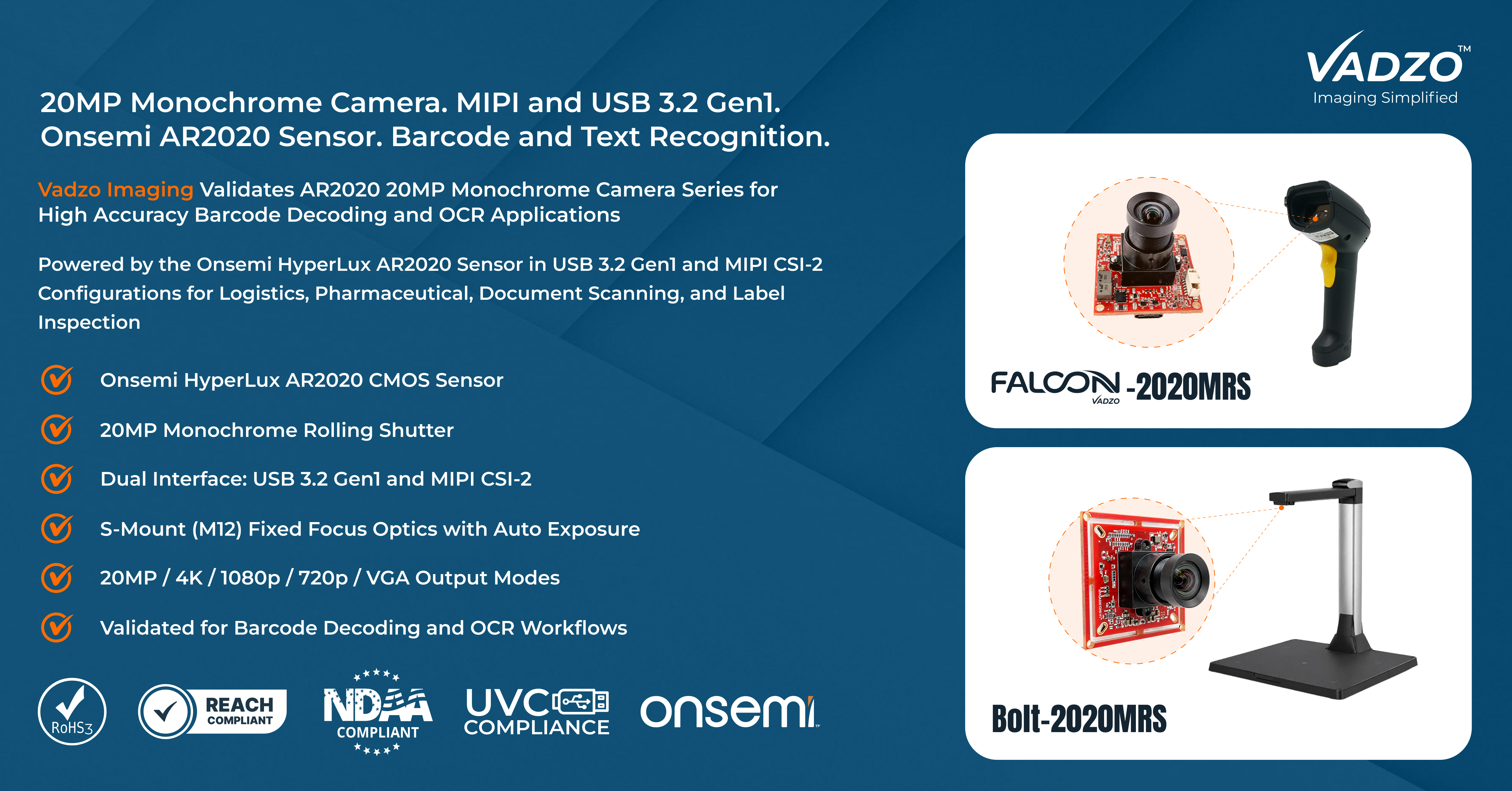
Key Capabilities of the Onsemi AR2020 20MP Monochrome Camera Series for OCR and Barcode Applications
20MP Spatial Resolution for Dense Symbol and Character Capture
Barcode decoding accuracy depends on resolving a minimum number of pixels per module, which is the smallest element in the barcode. At lower resolutions, camera products must be positioned closer to the target label to achieve this minimum, which limits the field of view and prevents the system from reading adjacent labels or wider label formats in a single image. The 20MP frame from this 20MP Barcode Camera provides the pixel density to cover wider label fields at longer working distances while maintaining the per-module pixel count required by ISO barcode grading standards. For OCR workflows, the same resolution advantage applies to small font sizes: at 6-point or 8-point text on pharmaceutical packaging, more pixels per character height directly raise the character recognition confidence scores produced by text recognition engines. The 20MP OCR Camera architecture is therefore appropriate for applications where font size or barcode density varies across production runs. Vadzo Imaging validated both the 20MP Mono camera for barcode decoding and the 20MP Mono camera for OCR application functions of this platform against real-world symbologies and label grades before release.
Monochrome Architecture for Artifact-Free Text and Symbol Fidelity
Color sensors use a Bayer color filter array over the pixel array. Each pixel in a Bayer sensor captures either red, green, or blue light, and the missing values at each location are reconstructed through demosaicking. On fine features such as narrow barcode bars or thin character strokes, the demosaicking process introduces spatial artifacts at contrast boundaries. These artifacts reduce the peak-to-valley signal amplitude at the edges that barcode decoders and OCR engines use to determine symbol start points and character outlines. This Monochrome OCR Camera removes the Bayer filter entirely so that every pixel captures luminance directly. This produces a sharper, higher fidelity edge profile at the 1.4 µm pixel pitch without any interpolation penalty. As a high-resolution monochrome camera platform, the AR2020 sensor increases first-pass read rates compared to grayscale conversion from a color sensor of equivalent resolution, particularly for GS1 DataMatrix codes, QR codes, and PDF417 symbologies with small quiet zones or high-density matrices.
Near Infrared Sensitivity for Multi-Illumination Barcode Reading
Many barcode scanning and document capture systems use near infrared illumination to minimize ambient light interference and achieve consistent illumination uniformity across a moving label surface. The Onsemi HyperLux AR2020 sensor delivers enhanced NIR sensitivity that allows the camera to operate effectively with 850 nm or 940 nm IR illumination sources. This is directly applicable to DPM Barcode Camera deployments where the mark reading system uses structured IR light to reveal low contrast laser etched or dot peen codes on metallic surfaces. It also applies to Document Scanning Camera systems that use backlit or UV reflective document transport illumination. The NIR response of the AR2020 sensor means the same camera module can serve visible light OCR workflows and IR illuminated barcode scanning on the same production line without changing the optical module.
USB 3.2 Gen1 Integration for Workstation Connected OCR and Inspection Systems
Machine vision barcode and OCR systems deployed at fixed inspection stations typically connect to industrial PCs or workstations running Windows or Linux. The Falcon-2020MRS OCR USB camera connects directly to any USB 3.2 Gen1 host port without a frame grabber or interface board. UVC class driver compliance means the camera streams immediately on connection under Windows, Linux, and Android without proprietary software installation. The USB 3.2 Gen1 bandwidth at 5 Gbps supports 20MP frame delivery at 15 frames per second, which is adequate for static or slow-moving label inspection. For high-throughput lines, the 4K mode at 30 fps or 1080p mode at 60 fps reduces bandwidth requirements while still providing sufficient resolution for standard barcode and OCR workflows. The AR2020 USB camera is therefore appropriate for pharmaceutical print verification stations, document archive scanning benches, and logistics label check stations where host PC integration is standard. Vadzo provides this camera as a fully qualified Onsemi AR2020 OCR Camera solution with validated driver support and application reference documentation included in every evaluation kit.
MIPI CSI-2 Integration for Embedded Inspection and Portable OCR Platforms
Portable barcode scanners, handheld OCR devices, in-vehicle barcode readers, and conveyor-mounted embedded inspection nodes require low-latency, low-power camera integration directly to the processor without USB controller overhead. The Bolt-2020MRS OCR MIPI camera connects directly to MIPI CSI-2 host ports on Raspberry Pi, NVIDIA Jetson, NXP i.MX, Rockchip, and similar SoCs through standard V4L2 Linux drivers. MIPI CSI-2 delivers lower latency than USB for frame capture, which reduces the total time to decode per label in high-speed barcode scanning applications. The AR2020 MIPI Camera supports the same 20MP, 4K, 1080p, 720p, and VGA output modes as the USB variant, so inspection algorithms validated on a workstation using the Falcon-2020MRS can be deployed unchanged on an embedded node using the Bolt-2020MRS with minimal software modification. This hardware portability is a core reason engineering teams choose this 20MP Mono MIPI camera for platforms where USB host availability is limited or where direct sensor lane access is required for minimum latency barcode capture.
S-Mount Optics Flexibility for Varied Working Distance and Field of View Requirements
OCR and barcode reading applications span a wide range of working distances, from close-range PCB traceability readers mounted at 50 mm standoff to postal sorting camera products reading parcel labels from 300 mm or more. The S-Mount (M12) lens mount on both the Falcon-2020MRS and Bolt-2020MRS accepts any standard M12 threaded lens, allowing the optical system to be configured for the specific pixel per module or pixel per character height requirement of each application. A narrow field of view lens at short working distance maximizes pixel density for small DPM codes and tiny font OCR. A wider field of view lens at a longer working distance covers multilabel panels or document width capture for Label Inspection Camera deployments on wide format packing lines. This optical flexibility means the camera module remains constant across different production line configurations, and lens substitution adjusts the imaging geometry without requiring a new camera module qualification.
Product Specifications
Parameter | Falcon-2020MRS | Bolt-2020MRS |
Sensor | Onsemi HyperLux AR2020 | Onsemi HyperLux AR2020 |
Resolution | 20MP (5120 x 3840) | 20MP (5120 x 3840) |
Pixel Size | 1.4 µm | 1.4 µm |
Optical Format | 1/1.8 inch | 1/1.8 inch |
Shutter Type | Rolling Shutter | Rolling Shutter |
Output Format | Monochrome | Monochrome |
Interface | USB 3.2 Gen1 | MIPI CSI-2 |
Lens Mount | S-Mount (M12) | S-Mount (M12) |
"OCR and barcode reading are validation-critical applications. A camera that fails one read cycle can cause a pharmaceutical labeling error or a misrouted parcel. We validated the AR2020 monochrome platform specifically against those workflows because 20MP resolution combined with a true monochrome sensor gives system integrators the pixel density and edge fidelity that these applications demand. The AR2020 Monochrome OCR Camera platform is available in both USB 3.2 Gen1 and MIPI CSI-2 configurations, so whether the deployment target is a fixed workstation or an embedded single board computer, engineers are working with the same validated sensor and the same image quality foundation." - Alwin Vincent, Product Manager, Vadzo Imaging.
Applications
Logistics and Warehouse Barcode Scanning
Distribution centers and warehouse automation systems scan thousands of labels per hour on packages, pallets, and totes. Labels vary in size, print quality, and orientation. The Logistics Barcode Camera requirement at these facilities demands high first-pass read rates even on damaged, smudged, or low contrast labels arriving on fast-moving conveyors. The 20MP monochrome sensor captures fine barcode structure with sufficient pixel per module density to decode degraded symbols that lower resolution camera products fail on. Auto exposure compensates for lighting variation along the conveyor without operator intervention. The Falcon-2020MRS connects directly to the inspection station PC over USB 3.2 Gen1, while the Bolt-2020MRS integrates into embedded conveyor-mounted vision nodes over MIPI CSI-2. Each deployment uses the same underlying Barcode camera validation that Vadzo Imaging conducted across real-world logistics label grades, ensuring consistent performance from evaluation to production rollout.
Pharmaceutical Serialization and Label Inspection
Pharmaceutical regulations, including the Drug Supply Chain Security Act and EU Falsified Medicines Directive, require serialized 2D barcode verification on each medication unit. These codes are printed at high density on small labels where print defects, varnish layers, and colored label backgrounds can reduce contrast. The Pharmaceutical Barcode Camera deployment must achieve near-zero false rejects and near-zero missed read rates to maintain line throughput while satisfying regulatory traceability requirements. The AR2020 20MP monochrome architecture captures 2D DataMatrix and QR code cells with the resolution margin needed to decode symbols near the lower end of their quality grade. Monochrome capture removes color-induced contrast variations that shift perceived barcode contrast under different label substrates. The Print Inspection Camera function of the same module allows the system to verify human-readable text, lot numbers, and expiry date printing in the same capture pass, eliminating the need for a second camera station.
Document Scanning and OCR Workflows
Archive digitization, postal letter reading, identity document verification, and forms of processing all require high-resolution monochrome capture followed by optical character recognition. The AR2020 20MP Document Camera provides the spatial resolution to capture A4 or letter-size documents in a single frame at a working distance appropriate for desktop or overhead scanning fixtures. At 20MP, a full-page document yields approximately 300 pixels per inch at standard page dimensions, which meets the minimum resolution recommended by most OCR engine vendors for mixed font size documents. The absence of Bayer interpolation artifacts on the Text Recognition Camera configuration preserves thin stroke fidelity at small point sizes, which is critical for multilanguage documents containing serif fonts, diacritical characters, or non-Latin scripts that depend on precise feature spacing for reliable recognition.
Print Inspection and Label Verification
Print and apply systems, laser coding stations, and inkjet marking lines require inline verification that every label is correctly printed before it reaches the finished goods area. The Print Inspection Camera requirement on these lines is a fast cycle time combined with sufficient resolution to detect missing characters, smearing, or barcode quiet zone violations. The AR2020 20MP monochrome sensor provides the resolution to verify both the machine-readable barcode and the human-readable text on the same label in a single captured frame without mechanical repositioning. Monochrome capture at the full 1.4 µm pixel pitch resolves individual inkjet dots and laser marks to flag low-quality print before it ships. The MIPI CSI-2 Bolt-2020MRS integrates directly into the machine controller over embedded Linux, while the USB 3.2 Gen1 Falcon-2020MRS connects to the line PC without additional hardware.
Postal and Parcel Automation
Postal sorting and parcel handling systems use barcode and address OCR to route items at high throughput. Labels include GS1-128 barcodes, Intelligent Mail barcodes, QR codes, and handwritten or printed address blocks that vary widely in font, size, and orientation. The Postal Barcode Camera requirement for these systems is consistent with read performance across the full label population, including partially obscured or low print quality items. The AR2020 20MP monochrome sensor covers a wide field of view at postal conveyor working distances while maintaining the per-symbol pixel density needed for reliable GS1 barcode decoding. Address block OCR on the same camera benefits from the high spatial resolution and clean edge profile that monochrome capture provides, enabling the OCR engine to parse handwritten and printed addresses in the same routing pass without a separate camera module.
Frequently Asked Questions
Q: Does higher resolution genuinely improve barcode read rates in industrial deployments?
A: Yes, and the improvement is measurable in application testing. Barcode grading standards such as ISO 15415 and ISO 15416 define minimum pixels per module requirements for reliable symbol decoding. When a camera delivers fewer pixels per module than the minimum, the decode algorithm encounters ambiguous transitions at bar edges, which causes missed reads or requires the label to be repositioned closer to the scanner. The 20MP sensor at 5120 x 3840 pixels provides a large resolution budget that allows the system to cover a wider field of view while still meeting the minimum pixels per module at typical label sizes and working distances. In validated testing at Vadzo Imaging, this additional pixel margin improved first-pass read rates on small 2D DataMatrix codes and high-density PDF417 labels compared to 5MP and 8MP alternatives evaluated under the same optical and lighting conditions.
Q: Why is monochrome better than color for text recognition and document scanning?
A: OCR engines and document scanning algorithms process pixel contrast, not color information. A color sensor applies to a Bayer filter array that restricts each pixel to capturing one of three color channels. The missing channel values at each pixel are estimated through demosaicking, a process that introduces interpolation artifacts at sharp luminance transitions. On thin character strokes, serif font details, and barcode bar edges, these artifacts reduce the contrast gradient that drives edge detection and feature extraction in the recognition engine. A monochrome sensor captures luminance at every pixel without any interpolation, preserving the sharpest possible edge transition at the native pixel pitch. This produces higher OCR character recognition accuracy on documents with small fonts, faded print, or mixed script text. Vadzo Imaging validated this advantage specifically against pharmaceutical label text and postal address block recognition in real application conditions, and the results confirmed measurably higher first-pass character and symbol recognition rates over equivalent resolution color sensors.
Q: How does this sensor handle DPM barcodes on metallic or rough surfaces?
A: Direct Part Marking barcodes are physically engraved, laser etched, or dot peened onto component surfaces. Unlike printed labels, DPM marks have no ink layer to create reflectance contrast. The contrast comes from surface texture differences between the marked and unmarked areas, and it varies with illumination angle and surface finish. Two sensor properties make this platform effective for DPM reading. First, the 1.4 µm pixel pitch at 20MP provides the spatial resolution to resolve individual dot positions in small DPM DataMatrix codes on components where the cell size may be less than 0.5 mm. Second, the HyperLux NIR sensitivity allows the camera to operate with oblique angle IR illumination, which is the standard technique for enhancing DPM contrast on metallic surfaces by creating differential shadowing across mark edges. Vadzo Imaging also supports custom optics and illumination selection through its OEM program to optimize DPM read performance for specific component geometries and surface conditions.
Q: Can this camera integrate into an existing print and apply line without custom driver development?
A: Yes. Vadzo Imaging provides UVC-compliant firmware for the USB variant, which makes it immediately recognized by Windows, Linux, and Android without proprietary software. For the MIPI CSI-2 variant, Vadzo provides V4L2 device tree overlays for Raspberry Pi, NVIDIA Jetson, and NXP i.MX and Rockchip platforms with integration documentation and reference capture scripts. Both variants stream standard image formats compatible with OpenCV, GStreamer, and most machine vision middleware frameworks. OEM customers that require integration with custom label inspection software or print and apply controllers receive engineering support from Vadzo, including camera initialization code, exposure tuning guidance, and application-specific optical configuration recommendations. No minimum order requirement applies to evaluation kits, and production quantities are available on standard lead times directly through Vadzo Imaging.
Q: What makes Vadzo Imaging the right partner for pharmaceutical or postal barcode verification?
A: Vadzo Imaging validates camera products against specific application workflows rather than publishing generalized sensor specifications alone. For barcode decoding and OCR, that means testing the 20MP monochrome platform against actual barcode symbologies, label grades, working distances, and illumination profiles used in target deployments, not just measuring sensor datasheet parameters in isolation. Vadzo also provides both a USB 3.2 Gen1 and a MIPI CSI-2 variant from the same sensor architecture, so system integrators can deploy the same validated imaging core on workstation-based inspection stations and embedded portable scanners without maintaining two separate camera qualification programs. The company supports OEM customers through hardware customization, lens selection, firmware modification, and module-level integration services, which reduces the total engineering cost and accelerates the timeline for a production-ready vision system.
Availability
The Falcon-2020MRS OCR USB camera and the Bolt-2020MRS AR2020 MIPI camera, both built on the Onsemi HyperLux AR2020 sensor and validated for barcode decoding and OCR applications, are now available for evaluation and production orders. Evaluation kits include the camera module, S-Mount fixed focus lens, interface cable, and platform driver documentation with no minimum order requirement. Browse the full Vadzo Imaging camera portfolio at https://www.vadzoimaging.com/ or contact Vadzo at [email protected] to request an evaluation kit or discuss OEM integration requirements.
About Vadzo Imaging
Vadzo Imaging is a global provider of embedded vision solutions and delivers high-performance camera technologies and imaging platforms for applications in robotics, industrial automation, UAVs, edge AI, and medical systems. Its products are designed for seamless integration with leading embedded platforms. Vadzo supports customers through hardware customization, firmware development, and module-level drivers, enabling faster development and deployment of vision-based systems.
Media Contact
Alwin Vincent
Vadzo Imaging
Email: [email protected]
LinkedIn: Vadzo Imaging
YouTube: Vadzo Imaging
X: Vadzo Imaging
SOURCE: Vadzo Imaging